Ventilation is not neutral. It carries its own energetic cost, rising non-linearly and becoming material at high intensity: what the respiratory muscles consume is not available to the locomotor muscles. Past a certain level of respiratory work, it triggers a metaboreflex that redistributes blood flow toward the diaphragm, at the expense of the legs. And its settings — frequency, tidal volume, expiratory time — govern gas exchange efficiency and the coupling with peripheral extraction. Breathing more is not a safety margin. It is a price.
One sentence circulates in the field: in the healthy athlete, the ventilatory system is not the ceiling of VO₂max. That is correct, and it is not what VST disputes. Cost, metaboreflex and extraction coupling are distinct from that ceiling: they do not set the maximal value, they determine what is left of it under constraint — at altitude, in the heat, late in a race, in week three. That is where they discriminate.
VST therefore treats ventilation as a metabolic driver: a system whose cost is measured, which is piloted as a lever, and mobilised as a recovery vector. Restructuring runs through the ventilatory pattern itself — an individualised frequency and tidal volume combination, per intensity zone — not through respiratory muscle strengthening alone.
The method therefore does not begin with a breathing exercise. It begins with a measurement problem: determining whether this particular rider has enough ventilatory margin to justify training it. Most do not. Identifying that quickly, and saying so, is part of the method.
VST is not a generic ventilatory model applied to every athlete. It is not inspiratory muscle training used as a standalone intervention. It is not a technique the rider performs in isolation from training.
Inspiratory loading is one lever among several, used when the profile indicates it. The determining input is the individual profile, not the protocol.
The premise
Ventilatory decoupling is a state, not a trait.
A rider whose ventilatory pattern degrades under load, altitude, heat or fatigue is not displaying a fixed characteristic. The pattern is a variable that responds to conditions, and it can be measured, tracked and modified.
This framing is testable, and it is what justifies longitudinal field monitoring rather than a single laboratory assessment. A one-off test describes a moment. It does not describe how the rider ventilates in week three of a stage race at altitude.
01 — Profile
Static capacity and dynamic pattern are mapped separately, then read against each other.
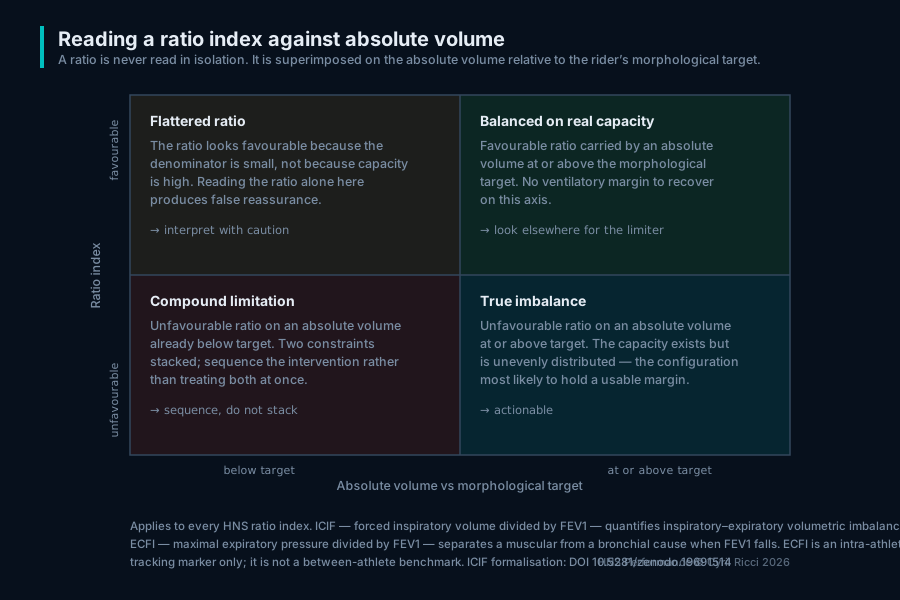
Static assessment covers forced expiratory and inspiratory volumes, maximal pressures, and the volumetric relationship between them. The ICIF (FIV / FEV1, formalised in the prior-art deposit, DOI 10.5281/zenodo.19691514) quantifies inspiratory-expiratory volumetric imbalance. The ECFI (PEmax / FEV1) distinguishes whether a fall in FEV1 is muscular or bronchial in origin — it is an intra-athlete tracking marker, not a between-athlete benchmark, and it is never presented as one.
Dynamic assessment records the ventilatory pattern across the full intensity range: sub-VT1, VT1, VT2 and beyond. Ventilatory frequency, tidal volume, ventilatory efficiency and their coupling with gas exchange and muscle oxygenation are recorded continuously.
Ratio indices are never read in isolation. Each is superimposed on the absolute volume relative to the rider's morphological target.
A favourable ratio on a small absolute volume is not the same finding as a favourable ratio on a large one.
02 — Analyse
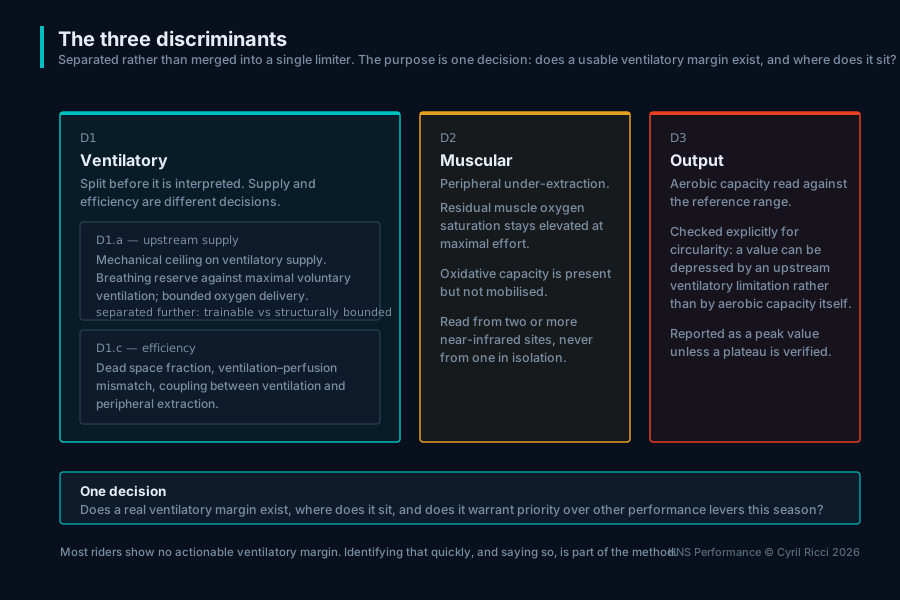
Three discriminants are separated rather than merged into a single limiter.
D1 — Ventilatory. Split before it is interpreted, because supply and efficiency lead to different decisions. The upstream component covers the mechanical ceiling on ventilatory supply: ventilatory reserve against maximal voluntary ventilation, and bounded oxygen delivery. Within it, what is trainable is separated from what is structurally bounded in the short term. The efficiency component covers dead space fraction, ventilation–perfusion mismatch, and the coupling between ventilation and peripheral extraction.
D2 — Muscular. Peripheral under-extraction. Residual muscle oxygen saturation remains elevated at maximal effort; oxidative capacity is present but not mobilised.
D3 — Output. Aerobic capacity read against the reference range, with an explicit check on whether the value is itself depressed by an upstream ventilatory limitation.
Supply and efficiency are separated because they lead to different decisions, not because one is trainable and the other is not.
The purpose of the analysis is a single decision: does a real ventilatory margin exist, where does it sit, and does it warrant priority over other performance levers for this rider in this season?
03 — Train
Prescription is built from the rider's own values. Nothing is transposed from another athlete.
Targets are expressed as a ventilatory frequency and tidal volume combination appropriate to each intensity zone, adjusted to current capacity rather than to a theoretical maximum. Volume targets that cannot be sustained are counterproductive; durability governs the prescription.
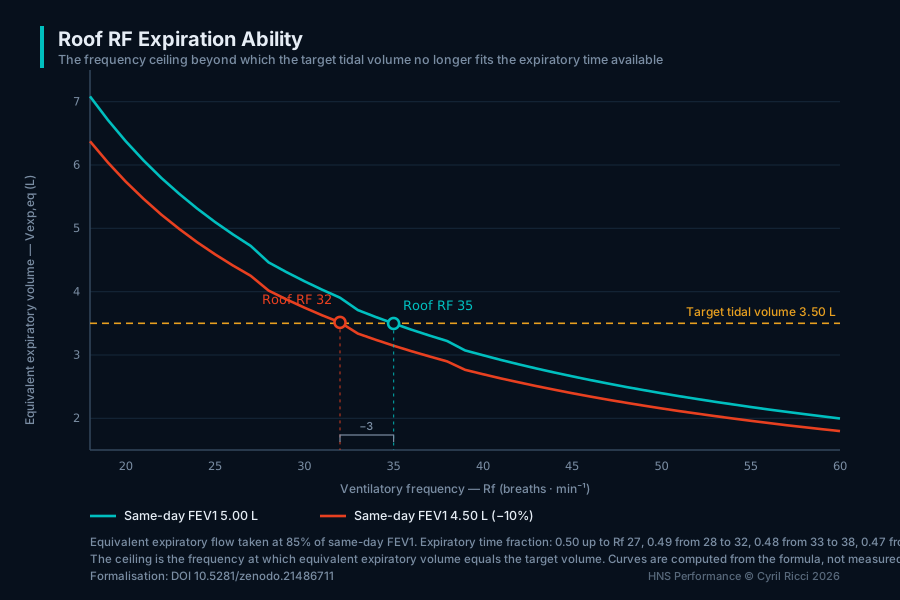
One constraint is calculated daily. The Roof RF Expiration Ability defines the frequency ceiling beyond which the target tidal volume no longer fits within the available expiratory time — expiratory equivalent flow taken at 85% of same-day FEV1, multiplied by expiratory time; the ceiling is the frequency at which that volume equals the target volume. When morning FEV1 falls, the frequency ceiling is lowered; the volume target is not. First published formalisation: DOI 10.5281/zenodo.21486711.
Roof RF Expiration Ability. The ceiling is the frequency at which equivalent expiratory volume equals the target volume. Curves are computed from the formula, not measured. Formalisation: DOI 10.5281/zenodo.21486711
Inspiratory loading, imposed nasal work below and at VT1, and timed strategies applied before, during or after efforts are deployed selectively according to the profile.
04 — Transfer to the field
Laboratory transfer is the point at which most ventilatory interventions fail, so it is treated as a measured phase rather than an assumption.
The pattern is monitored outdoors under real constraints: position, altitude, heat, accumulated fatigue and race-specific load. Power targets are corrected for altitude. Same-day spirometry anchors the daily ceiling. Deviation triggers recalibration rather than repetition.
The endpoint is the pattern becoming spontaneous — imposed initially, then adopted by the rider without instruction. That transition is documented, not assumed.
Instrumentation
Portable gas analysis, continuous ventilatory monitoring, field spirometry, near-infrared muscle oximetry at two or more sites, transcutaneous gas monitoring, inspiratory pressure measurement.
All measurements are field-based. Riders train normally; HNS monitors, analyses and recalibrates.
Evidence status
Findings are reported with their design attached and are not aggregated into a single claim of validation.
The 48-week longitudinal work in professional cyclists (Ricci & Bouverot) is deposited on Zenodo, DOI 10.5281/zenodo.16645438, and the manuscript is under review at the European Journal of Applied Physiology. The nasal versus oral comparison at the first ventilatory threshold is a preprint, SportRxiv, DOI 10.51224/SportRxiv.740, not peer-reviewed. The integrated monograph is an open-access deposit, not a peer-reviewed publication.
Reference values drawn from the HNS cohort (n=80) are unpublished; a publication is in preparation. They are internal benchmarks and are not presented as external consensus values.
The preservation branch of the method — the hypothesis that structured ventilatory work protects ventilatory function across loading blocks — is a testable hypothesis at an early stage of evidence. It is not presented as demonstrated.
In the absence of a randomised control group, the relative contribution of each component of the protocol cannot be isolated. That separation is the next experimental step, not a retraction of the effects observed.
Scope
Performance analysis. Not medical diagnosis. Functional observation without aetiological attribution.
HNS works alongside existing performance and medical staff and does not substitute for either.