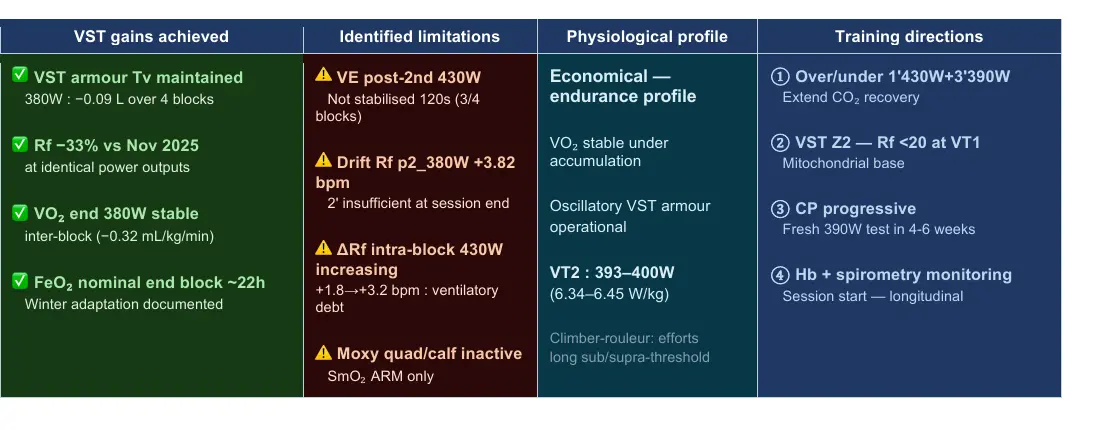
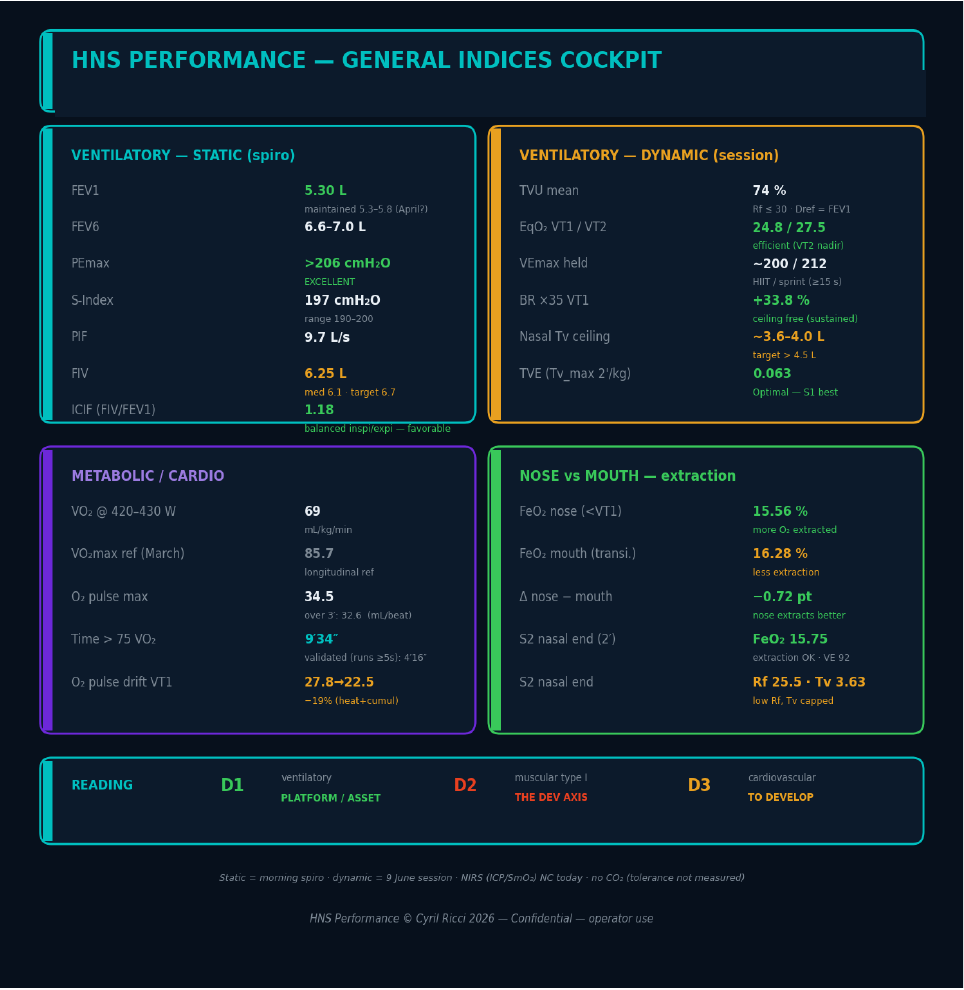
 Open full size ↗
COCKPIT 01 · INTEGRATED
General indices
Static ventilatory capacity, dynamic session behaviour, metabolic–cardiac response and route-specific extraction brought into one discriminant reading.
Field cases
The purpose of a field case is not to imitate a controlled trial. It is to expose the reasoning that connects a rider’s data to the next operational decision.
Reference longitudinal case
Seven weeks spanning heat monitoring, a reference test, an altitude camp and WorldTour racing. A complete sequence showing how an observation becomes a hypothesis, how it is confronted with the field, and how it generates the next test.
A 22-year-old climber: restored ventilatory reserve through lower equivalent-power cost while structural obstruction remained under medical governance.
OPEN CASE +Matched ramps, threshold work and repeated field references were compared across the intervention period.
Continue the trained pattern, preserve the medical boundary and reassess the residual expiratory constraint.
A long WorldTour session separates demand-driven Rf drift from loss of tidal-pattern stability and generates a testable recovery intervention.
OPEN CASE +Power, Rf, tidal trend, VE proxy, altitude exposure and accumulated load were read over comparable domains.
Treat the day-state rather than the rider as a trait; reduce the immediate target and verify recovery the next morning.
Route-specific efficiency tested indoors and outdoors, including the confounding effect of TT position on thoracic belt signal.
OPEN CASE +Matched nasal–oral blocks were cross-checked against gas exchange and route-specific belt calibration.
Use the route only inside its measured feasibility window; do not transfer an uncalibrated tidal ratio between positions.
Acute strategies examined before, during and after supra-maximal work, with power and VO₂ recovery read together.
OPEN CASE +Repeated efforts without and with strategy were compared, including power maintenance and the 30-second post-effort VO₂ response.
Retain only the sequence that improves repeatability or recovery without compromising peak work.
Repeated warm-up ramps and threshold blocks track whether a new ventilatory pattern survives heat, fatigue and training load.
OPEN CASE +Fixed comparison windows expose change at equivalent power rather than relying on session averages.
Recalibrate targets when the pattern no longer survives the rider’s real load context.
Device agreement is treated as condition-specific: frequency can be robust where uncalibrated tidal units remain trend-only.
OPEN CASE +Reference and wearable signals are paired by stable windows, route, position and intensity before agreement is quantified.
Use validated frequency in real time; keep uncalibrated tidal units for intra-athlete trend reading only.
Inside the monitoring system
The report does not stack isolated metrics. Each cockpit answers a different question: what the athlete can mobilise, how the pattern changes across comparable work, and which axis should govern the next intervention.
Open full size ↗Static ventilatory capacity, dynamic session behaviour, metabolic–cardiac response and route-specific extraction brought into one discriminant reading.
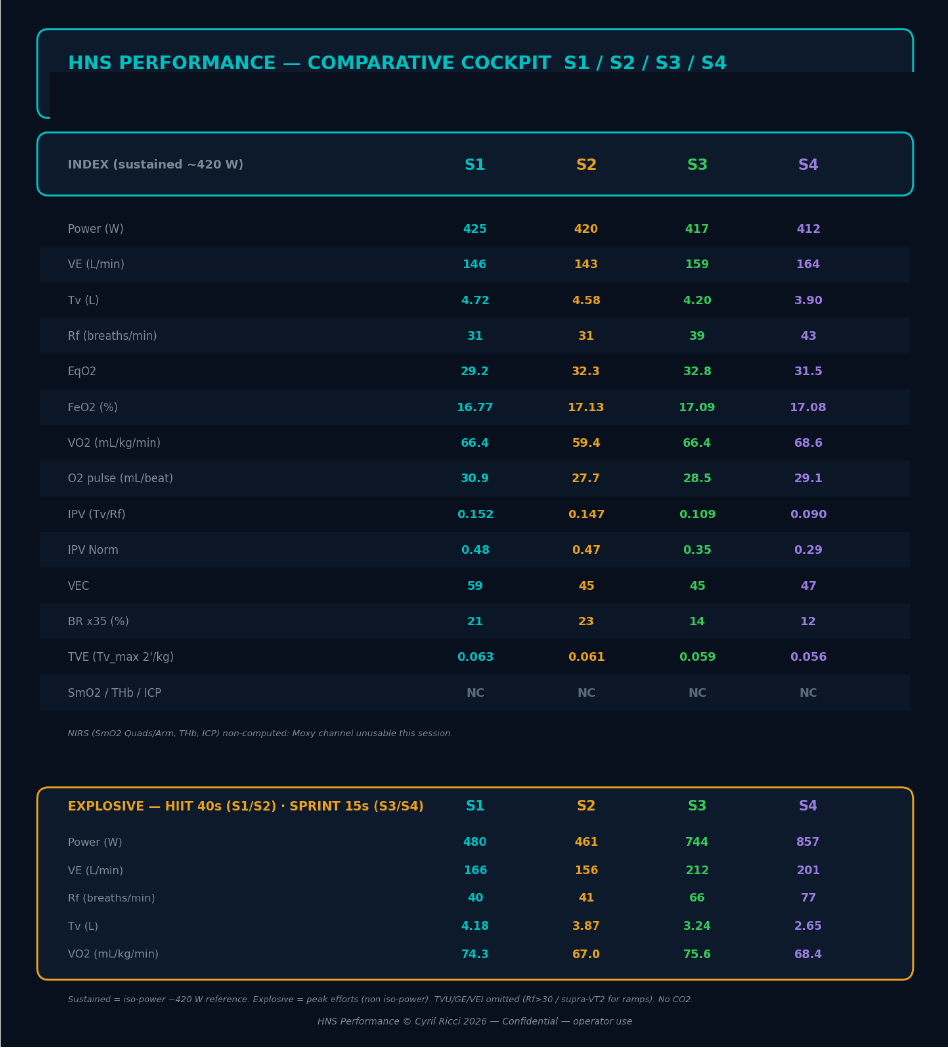 Open full size ↗
Matched-power comparison across four blocks separates an efficient controlled pattern from accumulated drift and sprint-specific behaviour.
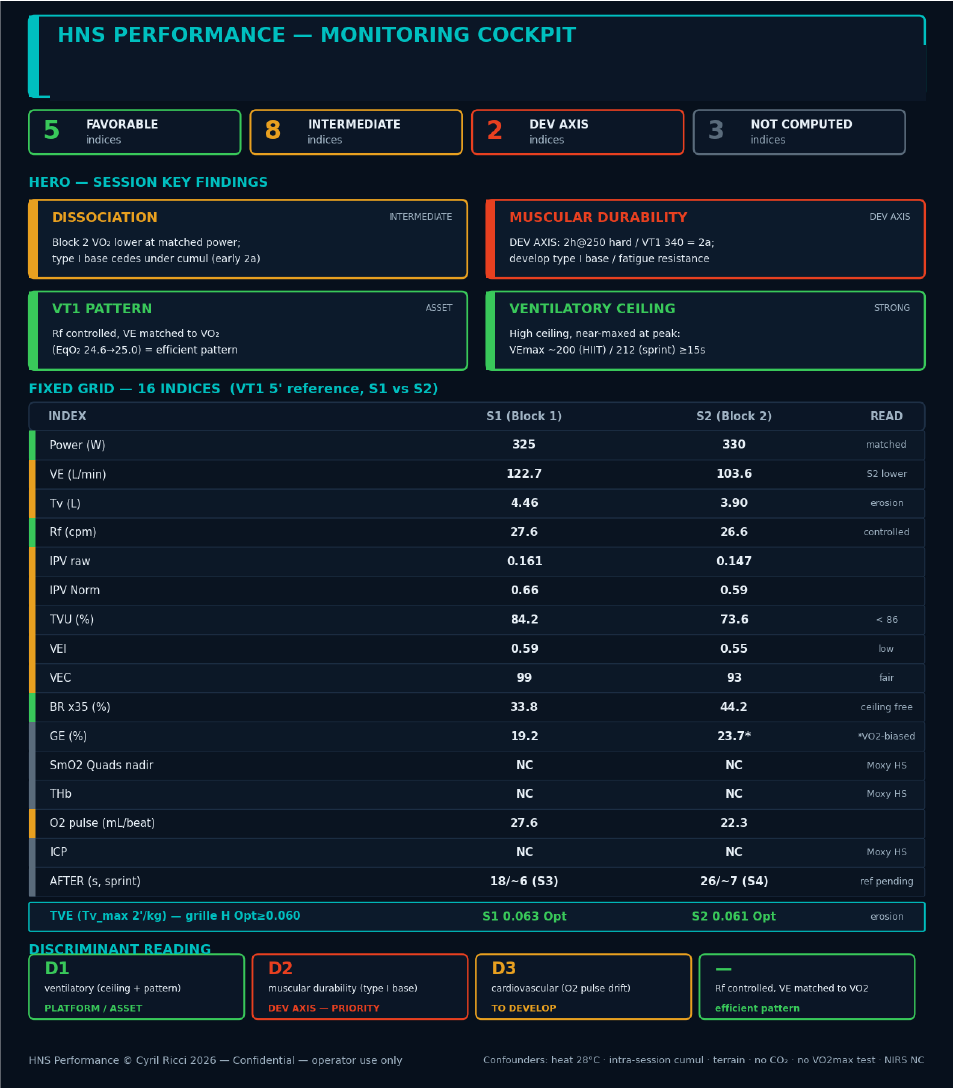 Open full size ↗
Sixteen fixed indices, four hero findings and a final D1–D3 reading expose the asset, the development axis and the staff priority.
Real WorldTour field data. Athlete name, date, team context and identifying characteristics have been removed. No complete confidential report is published.
Anonymised monitoring extract
The value is not the number of charts. It is the ability to show what improved, what still fails under accumulated load and what the staff should test next.